Trading Meme Coins With a $10 Portfolio
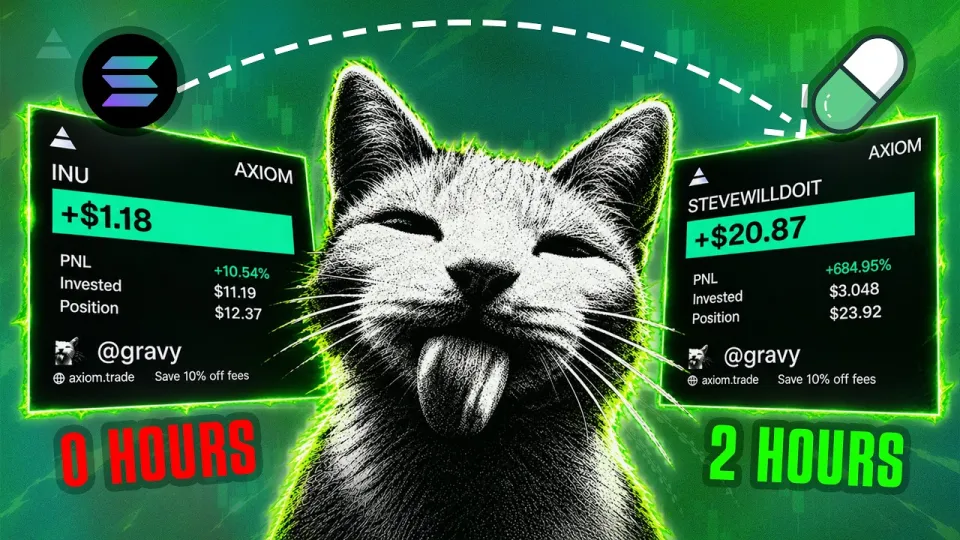
Video: I Tried Trading Memecoins with Just $10
You can order the same kind of articles for your own video to boost it on YouTube and Google. Just message the Telegram bot @sat_sit_bot. The bot writes and publishes the articles itself (with your YouTube video embedded) on popular topical websites (no ads). Your first 50 articles are free.
· based on the channel gravy
Meme coins can be traded with a $10 portfolio, but the strategy has to change: position size, fee tolerance and exit discipline matter more than the size of the bet. A small balance rules out averaging down and forces you to take profits on the first leg rather than waiting for a runner. The clearest demonstration of this is a five-trade experiment on Solana in which every buy stayed under 0.05 SOL, documented by the channel gravy in the video "I Tried Trading Memecoins with Just $10" and executed through Axiom's trading terminal.
What a $10 meme coin portfolio can realistically do
A $10 balance is not a smaller version of a $1,000 account; it is a different game entirely. On Solana, a swap costs a network fee plus a platform fee plus slippage, and on a 0.04 SOL buy those costs can swallow a meaningful slice of the position before the price moves at all. That means the goal is not to compound aggressively but to avoid bleeding out on round trips.
- Position size: in the experiment, no buy went above 0.05 SOL, which keeps a single bad call from wiping the account.
- Number of trades: five trades were enough to show the pattern — a couple of winners, one hard fumble, several small outcomes.
- Exit speed: on a small balance, waiting for a 3x usually means giving back the 40% you already had.
- Fee drag: every extra in-and-out costs a fixed amount that does not shrink with your position, so fewer, better trades beat constant churn.
A useful rule for anyone starting small: count the round-trip cost before entering, and skip the trade if the realistic upside does not clear it by several times.
Five real trades and the narratives behind them
The experiment traded tokens chosen for a story rather than for chart patterns, and the write-up of each entry is the most transferable part of the video. Narratives are what move meme coins on Solana: a ticker attached to a live conversation on X can run for hours, while a ticker with no story dies in minutes.
- STEVEWILLDOIT — the opening trade, built around a meme character with an existing internet following.
- NPC — a token riding the "NPC" internet archetype, a familiar label that spreads fast on social feeds.
- MET (Meteora) — a play on a real Solana project name, the kind of ticker that attracts attention because it looks official.
- PUMPY the Trader — a character-driven coin tied to trading culture itself.
- UNTXD — the last trade, and by the host's own account the one he mishandled badly.
Around the second trade, the video breaks down why the X Money coin meta ran, pointing to e/acc and Cream as the cultural fuel behind it. That is the mechanism worth internalising: a coin does not need fundamentals, it needs a live, legible conversation that new buyers can join in seconds.
Why narrative timing beats chart reading on Solana
Meme coin trading on Solana is mostly a timing problem, and timing is set by attention, not by technical levels. A token's price responds to how many people are hearing about it right now, which is why the same chart pattern produces completely different outcomes on two different tickers.
This is also the hardest part for beginners, and the most common complaint among viewers of the video: keeping up with which accounts carry influence, which jokes are currently circulating, and which ticker is the one the crowd has agreed on. The practical response is to narrow the funnel rather than widen it.
- Follow a small, fixed list of accounts that reliably surface new metas early, instead of scrolling a feed full of noise.
- Track the joke, not the token: if the underlying meme is still spreading, the ticker can have a second leg.
- Treat a token that has already gone vertical as a different trade with different risk, not as the same idea entered late.
- Write down the reason for the entry before buying. If the reason disappears, the position should too.
Fees, slippage and the small-balance trap
Fees are the reason most people say a $10 portfolio cannot work, and they are right about the mechanics even when they are wrong about the conclusion. The fixed costs of a swap are identical whether you trade 0.04 SOL or 4 SOL, so they consume a far larger percentage of a small position.
That produces a specific failure mode: a trader takes a 25% gain, pays the round trip, and ends up roughly flat, then repeats until the balance is gone. The fix is to size exits around the cost structure — take the trade only when the expected move is large relative to fees, and avoid the temptation to "just try" a position so small that it can never pay for itself. Platform choice matters here too; the video's host promotes a referral arrangement on Axiom that advertises doubled cashback and a fee discount, which changes the math at the margin but does not change the underlying principle.
Common questions from small-balance traders
Small-portfolio trading raises the same handful of doubts every time, and they are worth answering directly. The first is whether a $10 account is even worth the effort: it is, as a training ground, because the decisions are identical to a large account while the cost of mistakes is trivial. The second is how to find narratives without drowning in social media — the answer is curation, not more information.
The third recurring issue is the emotional one, described repeatedly by viewers: selling after a 20–40% loss and then watching the token run higher. That pattern usually comes from entering without a thesis and therefore having no basis for holding through a drawdown. The fourth is transparency about results — a fair criticism of the experiment is that it walks through each trade but never states a clean total profit-and-loss figure, which is exactly the number a viewer needs to judge whether the approach works.
Useful links
- Axiom trading terminal with the host's referral: https://axiom.trade/@gravy
- The Trenches Discord: https://discord.gg/W7TqkExcSd
- Discord with free Axiom imports and trade signals (not financial advice): https://discord.gg/9W5j3XUgYB
- Host's X account: https://x.com/gravyski
- Leverage trading with a 20% futures fee reduction: https://www.bitbase.com/landing-page/trading-earning-Gra?ref=8CYOGY
Bottom line
A $10 meme coin portfolio is viable as a discipline exercise rather than as an income plan: five trades under 0.05 SOL each on Solana show that the mechanics work, while the fee drag and the one badly handled exit show where the money actually leaks. The transferable lessons are position sizing, entering only on a live narrative, and exiting before fees and slippage turn a winner into a flat trade. The channel gravy is upfront that the experiment is small-scale, and the natural next step it raises is live trading from a public wallet starting at 0.1 SOL or 1 SOL. Anyone repeating the exercise should track total profit and loss from the first trade, since that single number is what separates a learning experience from a strategy. To follow the same route, start with a registration on Axiom via the referral link and keep the first buys small.
Key takeaways
- Five trades were made on Solana, and no single buy exceeded 0.05 SOL.
- Tickers covered: STEVEWILLDOIT, NPC, MET (Meteora), PUMPY the Trader and UNTXD.
- The X Money coin meta ran on an e/acc and Cream narrative, according to the video.
- Fees and slippage are the main constraint on a $10 balance, not the size of the trade.
- The host floats a live-trading follow-up starting from 0.1 SOL or 1 SOL.
Questions & answers
Can you actually trade meme coins with only $10?
Yes, mechanically — the experiment in the video completes five Solana trades with no single buy above 0.05 SOL. The constraint is economic rather than technical: fixed swap fees and slippage take a larger share of a small position, so each trade needs a bigger expected move to be worth taking.
How do you find meme coins with a good narrative?
Narrative discovery is about curation, not volume. Follow a short list of accounts that consistently surface new metas early, track whether the underlying joke is still spreading, and write down the reason for each entry so you know when it has stopped being true.
Why do small traders sell at a 20–40% loss and then watch the coin recover?
Usually because the entry had no thesis, so there was nothing to hold onto during a drawdown. Deciding in advance what would invalidate the trade — a dead narrative rather than a red candle — makes it possible to sit through normal volatility instead of exiting at the worst point.
What should a beginner track when trading a small portfolio?
Total profit and loss across all trades, including fees. Reviewers of the experiment correctly noted that per-trade explanations without a final P&L figure make it hard to judge whether the approach works, so log every entry, exit and cost from the first trade onward.
Source: I Tried Trading Memecoins with Just $10 · Markdown version