Flash USDT provides a reliable way to create and test USDT tokens using ChainIDE and MetaMask
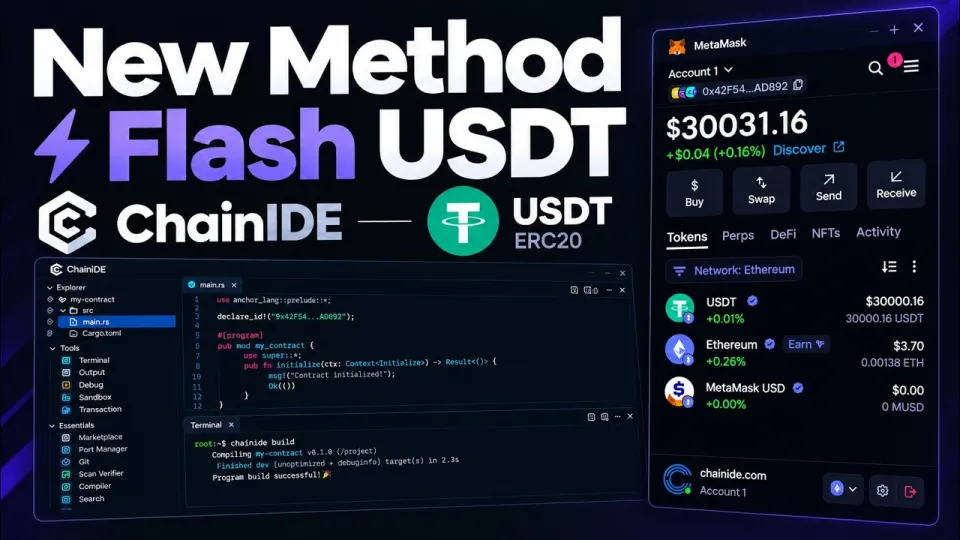
Video: Flash USDT | Found a NEW Method on ChainIDE
· based on the channel Rca FastPrint
Flash USDT is a method designed to create and interact with USDT tokens by leveraging the ChainIDE development environment and MetaMask wallet. This approach allows developers and enthusiasts to build, test, and verify USDT tokens based on the ERC20 standard without risking real funds on unverified contracts. To get started, users register and access ChainIDE at chainide.com, which provides the tools necessary for smart contract development and deployment.
Understanding Flash USDT and Its Purpose
Flash USDT is essentially a workflow that demonstrates how to create USDT tokens rapidly using smart contract programming within ChainIDE. It focuses on the ERC20 token standard, the foundation for most tokens on Ethereum including USDT. The method showcases the token structure, deployment, and interaction via MetaMask, emphasizing an educational and testing environment rather than live production.
Setting Up ChainIDE for Flash USDT Development
ChainIDE is a web-based integrated development environment tailored for blockchain developers. It supports multiple blockchain networks and facilitates writing, compiling, and deploying smart contracts.
To use ChainIDE for Flash USDT:
- Register or log in at chainide.com.
- Create a new project and select the Ethereum network.
- Write or import the ERC20 smart contract code for USDT.
- Compile the contract using the built-in Solidity compiler.
- Deploy the contract to a test network or a compatible Ethereum environment.
This setup enables quick iterations and testing without needing extensive local infrastructure.
ERC20 Token Structure in Flash USDT
The USDT tokens created via Flash USDT follow the ERC20 standard, which defines the essential functions and events for fungible tokens on Ethereum. The key components include:
- `totalSupply`: The total number of tokens available.
- `balanceOf`: Returns the token balance of a given address.
- `transfer`: Moves tokens from the sender to a recipient.
- `approve` and `transferFrom`: Allow delegated token transfers.
The Flash USDT smart contract demonstrates these in a simplified form for learning and testing purposes. Understanding these functions is crucial for interacting correctly with any ERC20 token.
Connecting MetaMask to Interact with Flash USDT
MetaMask is a widely used Ethereum wallet browser extension that allows users to manage accounts and sign transactions.
To connect MetaMask with Flash USDT:
- Install MetaMask and create or import an Ethereum wallet.
- Switch MetaMask to the network where the Flash USDT contract is deployed (e.g., Ethereum testnet).
- Use ChainIDE or a web3 interface to interact with the contract via MetaMask.
- Approve transactions when prompted to execute token transfers or contract interactions.
This connection enables seamless testing of token functionality while keeping control over private keys.
Testing and Verifying the Flash USDT Setup
Testing is a critical phase to ensure the Flash USDT tokens behave as expected. Key steps include:
- Checking contract deployment success and retrieving the contract address.
- Using MetaMask to query balances and execute token transfers.
- Verifying that the token supply and balances update correctly.
- Reviewing transaction details on blockchain explorers to confirm contract interaction.
- Avoiding sending real funds or interacting with unverified contracts to prevent losses.
Following these steps ensures a safe and effective learning experience.
Common Mistakes and Precautions When Using Flash USDT
When working with Flash USDT and smart contracts, watch out for:
- Interacting with unverified or malicious contracts.
- Sending real funds during testing phases.
- Incorrect network settings in MetaMask causing failed transactions.
- Overlooking gas fees and transaction limits.
Always double-check contract addresses, review source code independently, and use test networks for experiments.
Useful Links
- ChainIDE official site and registration: https://chainide.com/
- Flash USDT creation script and resources: https://sites.google.com/view/defiflashusdt
Итог
Flash USDT offers a straightforward and educational method to create and test USDT tokens using ChainIDE and MetaMask within the Ethereum ecosystem. This approach emphasizes safe development practices by leveraging test networks and verified workflows. For anyone interested in ERC20 token development or DeFi education, the Flash USDT method is a valuable resource. The channel "Rca FastPrint" provides a comprehensive walkthrough and insights that help demystify the process. Visit chainide.com to start experimenting with smart contract development today.
Key takeaways
- Flash USDT uses ChainIDE for smart contract development and testing
- USDT tokens are created as ERC20 tokens on the Ethereum network
- MetaMask connects wallets to interact with Flash USDT contracts
- ChainIDE offers an integrated environment for smart contract coding and deployment
- The method is educational and requires cautious verification before real use
Questions & answers
What is Flash USDT and what is it used for?
Flash USDT is a method to create and test USDT tokens on the Ethereum blockchain using smart contract development tools like ChainIDE. It is primarily educational, allowing users to understand ERC20 tokens without risking real money.
How does ChainIDE facilitate Flash USDT development?
ChainIDE is a web-based IDE that allows users to write, compile, and deploy smart contracts. It supports Ethereum and enables developers to test Flash USDT contracts quickly on test networks.
Why is MetaMask important for interacting with Flash USDT?
MetaMask acts as a wallet and gateway to Ethereum networks, allowing users to manage keys and sign transactions. It connects to Flash USDT contracts to enable token transfers and contract interactions securely.
Can I use Flash USDT method with real funds?
No, the Flash USDT method is intended for educational and testing purposes only. Users should never send real funds to unverified contracts and must verify all code and addresses before any real interactions.
Source: Flash USDT | Found a NEW Method on ChainIDE · Markdown version